Evidence in action

Should firms reorganize around AI?

A diagnostic walk through the Galbraith Star Model, stress-tested against three recent findings: P&G's field experiment, human-LLM-OR inventory complementarity, and Coase versus Claude.

The question

Not "should we use AI" — but "should the org chart change."

Most AI debates argue about tools. This one argues about structure. If an AI-augmented individual can match a two-person team, if the best decisions come from humans and machines together, and if AI collapses the coordination costs that justified the firm in the first place, then the live question is not adoption. It is reorganization.

How to read this page: three findings supply the evidence, the Coasean lens supplies the theory, and the Galbraith Star supplies the diagnostic. The verdict at the end is deliberately balanced — reorganize the parts the evidence touches, and resist the urge to reorganize everything.

The three readings

What the evidence actually says

Two recent empirical studies and one theoretical essay. Skim the abstracts and results; the numbers below are pulled straight from the papers.

Field experiment

The Cybernetic Teammate

Dell'Acqua, Lakhani et al. — 776 P&G product innovators, pre-registered

Individuals working with AI matched the output of two-person teams without AI. AI also broke down expertise silos: R&D and Commercial staff converged on similar-quality, more balanced solutions, and reported more positive emotions while working.

NBER w33641 →
Benchmark + experiment

AI Agents for Inventory Control

Baek et al. — InventoryBench, 1,000+ inventory instances

Across synthetic and real demand data, the strongest setup is not any single approach but a combination. An LLM-plus-OR pipeline beat either method alone, and human-plus-AI teams earned higher profits than humans or AI agents operating on their own.

arXiv 2602.12631 →
Theory

Coase vs. Claude

Howard Yu — the theoretical anchor

Coase asked in 1937 why firms exist at all: because some activities are cheaper to internalize than to buy on the market. Yu argues that when AI drives coordination, search, and monitoring costs toward zero, that boundary moves — and the firm starts to look like a platform of micro-enterprises.

Read the essay →
The data

Two findings, in numbers

The headline results, charted from the published point estimates. The shape of both is the same: AI does not just speed the existing structure up — it changes who can do the work, and with whom.

AI lifts the individual to team level

Cybernetic Teammate — solution quality vs. a solo worker without AI

0 0.1 0.2 0.3 0.4 Two-person team, without AI +0.37 SD +0.39 SD Solo worker + AI Two-person team + AI Baseline (0) = a solo worker without AI
Teams with AI were more likely to produce a top-tier solution.

Point estimates: +0.37 SD (individuals) and +0.39 SD (teams), both p<0.01. The dashed line marks the level of a two-person team without AI — which AI-augmented individuals reached on their own.

The best team is human + machine + machine

InventoryBench — performance score (higher is better)

0 0.2 0.4 0.6 ~0.44 0.538 +21% OR algorithm alone LLM → OR pipeline
In the classroom experiment, human + AI teams beat humans or AI alone on profit.

The LLM-to-OR pipeline scored 0.538, a 21% improvement over the OR algorithm alone (implied ~0.44). Methods proved complementary, not substitutes — the gains come from combining them.

Both studies point the same way: AI is most powerful as a teammate, not a replacement — and that reshapes how teams are sized and staffed, not just how fast they move.
The theoretical lens

Coase asked why firms exist. AI rewrites the answer.

Firms exist, Coase argued, because internalizing some activities is cheaper than buying them on the market. Yu's claim is that AI collapses the very costs — coordination, search, monitoring — that made internalizing cheaper. As that boundary moves, some work flows back out to the market, and a different set of activities becomes more compelling to keep inside, not less.

Push back to the market

Where AI drives transaction costs below the cost of internal management.

  • Routine coordination and scheduling
  • Supplier sourcing and contract drafting
  • Quality monitoring and status reporting
  • Modular work units an agent can orchestrate
AI collapses coordination, search & monitoring costs

Pull deeper inside

Where value rises precisely because everything else got cheap and noisy.

  • Brand identity and trust as a filter
  • Capital to absorb failed experiments at scale
  • Platform accountability and the standard
  • High-stakes human judgment

Yu's examples push the point: Shein atomized design into micro-decisions where Zara held an integrated collection; Figma made the element, not the file, the unit of work; Haier reorganized 80,000+ employees into 4,000+ self-managing micro-enterprises under one platform brand. The firm does not vanish — it becomes a platform orchestrating a network.

The diagnostic

Walking the Galbraith Star

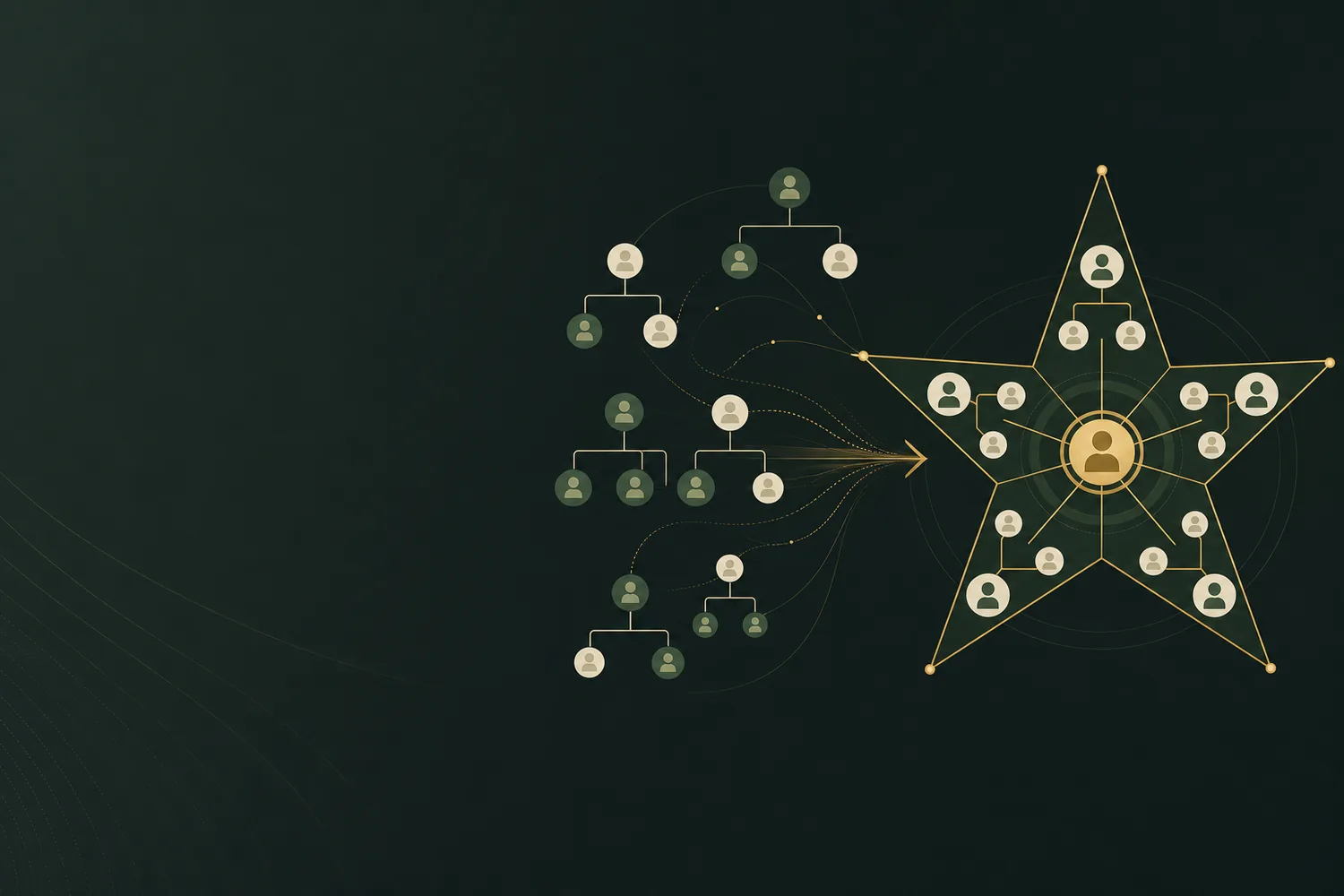
Galbraith's model says an organization is healthy only when five points stay aligned: Strategy, Structure, Processes, Rewards, and People. Change one and the others must rebalance, or the system misfires. AI hits some points hard — and companies routinely forget to re-tune the others.

Strategy

AI pressure

What becomes possible when a solo operator has team-level output? New service levels, faster cycles, smaller bets.

Structure

AI pressure

Smaller teams, fewer hand-offs, blurred functional silos. The "two-person team" finding lands hardest here.

Processes

AI pressure

Human + LLM + OR hand-offs, review gates, and the determinism bridge replace single-owner workflows.

Rewards

Often un-rebalanced

Still pay for individual heroics and headcount, and AI leverage stalls. The point companies most often forget.

People

Often un-rebalanced

Roles shift from doing to directing and reviewing. Skills, hiring, and reporting lines lag the new structure.

For the room

Four questions to pre-think

Bring one or two. These anchor the small-group discussion — each one turns a finding into a decision about your own firm.

From Cybernetic Teammate

Smaller teams, fewer specialists, or just better tooling?

AI-augmented individuals matched two-person teams, and R&D and Commercial converged on similar-quality solutions. If that holds in your firm, does it argue for smaller teams, fewer functional specialists, or simply better tooling on top of today's structure — and where does the finding break down?

From Baek

Who is the third teammate you don't yet have?

The best inventory team was human + LLM + OR, not any one alone. Pick a function in your company: who is the third member of that team you haven't hired yet — and what changes about hiring, training, and reporting if you take the finding seriously?

From Coase vs. Claude

What do you push out — and what do you pull in?

If AI collapses coordination, search, and monitoring costs toward zero, which activities would you push back out to the market — and which become more compelling to keep inside, not less?

Walking the Star

Which point gets hit — and which gets forgotten?

Across Strategy, Structure, Processes, Rewards, and People: which point does AI hit hardest in your industry, and which is most often left un-rebalanced — causing the rest of the system to misfire?

The verdict

So — should firms reorganize around AI?

Yes, but not the way the hype implies. The evidence supports rebalancing the Star around real findings — and resisting the urge to blow up the whole org chart on the strength of a demo.

Reorganize

Structure and Processes. Size teams around AI-augmented individuals, design human + machine hand-offs, and dissolve silos the evidence shows AI already bridges.

Re-tune first

Rewards and People — the points companies forget. Pay for leverage and judgment, not headcount and heroics; retrain roles from doing to directing before the structure changes.

Hold the line

Keep brand, capital, accountability, and high-stakes judgment inside. Push routine coordination out. Reorganize where coordination cost actually collapsed — not everywhere.

The Day One Leader read: the same discipline applies here as everywhere in the guide. Start with the work, not the org chart. Pick the point on the Star where the evidence is strongest, change it deliberately, re-tune the points around it, and measure whether the system got healthier — not just faster.

Sources

Read the originals